
Industry News · November 2026
Isha Ambani's AZORTE Has AI Trial Rooms. Here's How Any Clothing Brand Builds Its Own AI Try-On Room
When the head of India's largest retailer puts AI inside the changing room, every clothing brand in the country notices. Reliance Retail's fashion brand AZORTE, under Isha Ambani's leadership, has been in the news for its smart trial rooms, where a screen inside the room lets shoppers ask for a different size or a matching outfit without stepping out. It is a clear signal of where Indian fashion retail is heading. The good news for every other brand: you do not need Reliance's budget to give your shoppers an AI trial room of your own.

Key takeaways
- AZORTE's smart trial rooms, as reported, recognise garments by RFID and let shoppers request sizes and styles from an in-room screen.
- That speeds up the physical changing room. AI virtual try-on goes one step earlier: shoppers see themselves wearing the garment without changing at all.
- Any clothing brand can add an AI try-on room with a screen and a camera, no RFID tagging or in-house AI team required.
- TryOnCloud works for men's, women's and kids' wear, Indian and Western, for festive and wedding wear of every community.
- Public pricing is ₹9 to ₹6.50 per try-on, bought once and never expiring.
What Isha Ambani's AZORTE launched: Reliance Retail's smart AI trial rooms
AZORTE is the premium fashion brand of Reliance Retail, the retail arm led by Isha Ambani. According to press coverage of its stores, AZORTE's trial rooms are fitted with screens connected to RFID tags on the garments. When a shopper carries clothes into the trial room, the system is reported to recognise each item automatically and show it on the screen inside the room.
From that screen, shoppers can reportedly tap to request a different size or a different style, and store staff bring it to the room. Coverage also describes the stores as AI-led and technology-forward, positioned as an Indian answer to global fast-fashion chains, and mentions further personalisation features planned for the future. As with any company announcement, these are the brand's and the press's descriptions, and the exact rollout varies by store.
What matters for the rest of the industry is the message. Shoppers in India's biggest cities are now being shown that the trial room itself can be smart. Once a shopper has used an AI-assisted changing room at a flagship store, the ordinary curtain-and-hook trial room at the next shop feels a step behind.
AZORTE smart trial room vs an AI virtual try-on room
The phrase "AI trial room" is being used for two different technologies, and a brand planning its own should know which one it is buying. A smart trial room makes the physical changing room more efficient. An AI virtual try-on room lets the shopper see the garment on their own body before they change at all. They are not competitors; the strongest setup uses both.
| Smart trial room (AZORTE style) | AI virtual try-on room (TryOnCloud) | |
|---|---|---|
| What it does | Recognises garments you carried in and lets you request another size or style from a screen | Shows the shopper wearing a garment, generated from a photo of their own body |
| Does the shopper change clothes? | Yes, it speeds up the physical try-on | No, the shopper sees the look first and only takes the final picks into the room |
| Garment limit | Only items physically in the room | Any item in your catalogue, or any garment held up to the camera |
| What it needs | RFID tags on stock, in-room screens, integrated store systems | A screen with a camera, or the shopper's own phone |
| Built for | Large chains with a retail technology team | Any brand, from one boutique to hundreds of stores |
| Best used for | Confirming the final size | Shortlisting fast, especially for occasion and ethnic wear |
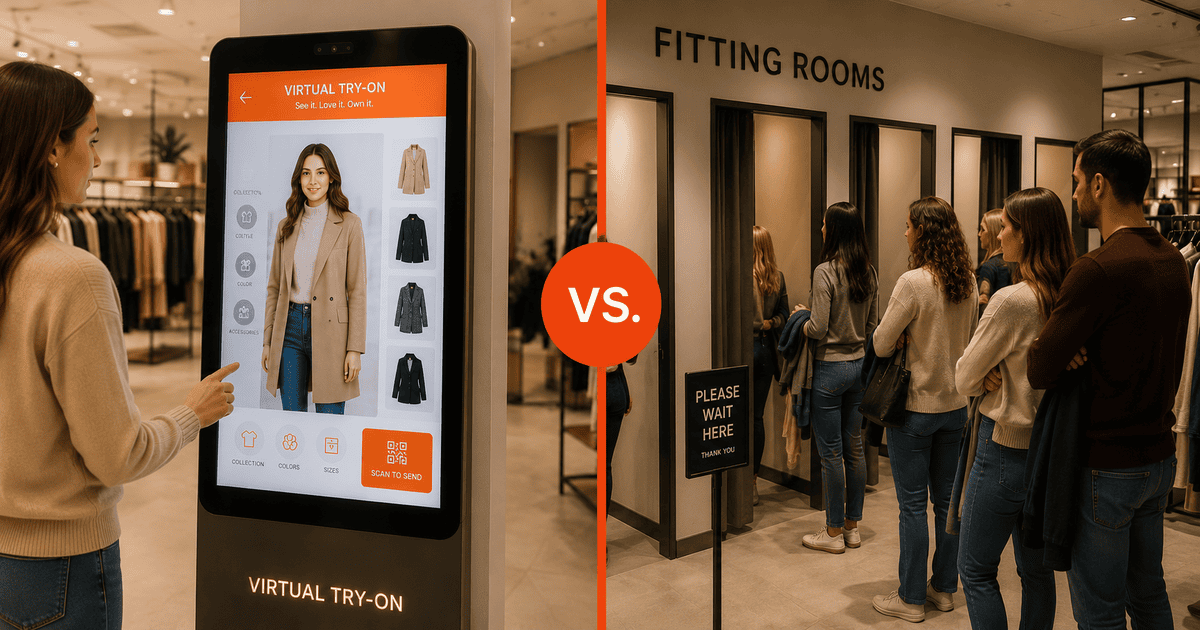
For Indian fashion in particular, the difference is large. Trying on a saree properly takes time and help. Changing into a lehenga or a sherwani for every option is slow for the shopper and for the staff folding everything afterwards. An AI try-on room lets a shopper compare five sarees in the time it takes to drape one, then take only the favourite into the trial room.
Why every clothing brand needs an AI trial room now
When a retailer the size of Reliance puts AI in its trial rooms, it resets what shoppers expect. Brands that sell in the same malls and high streets will be compared to that experience, whether they like it or not. The brands that move early get to own the "AI try-on" story in their city before it becomes standard.
- Faster decisions on high-value pieces. Bridal and festive wear is where shoppers hesitate most. Seeing the outfit on themselves, and sending it to family on WhatsApp, helps them decide in the store.
- Shorter trial room queues. On festival weekends the trial room is the bottleneck. Shoppers who shortlist on a screen take fewer items into the room.
- Less handling of delicate stock. Every trial of a silk saree or an embroidered lehenga risks creases, makeup marks and damage. Virtual trials spare the garment.
- A reason to visit. An AI try-on screen is something shoppers photograph and talk about. It works as in-store marketing as well as a sales tool.
- Works for online shoppers too. The same engine powers try-on on your website or Shopify store, so the experience is consistent everywhere you sell.
We deliberately do not quote invented conversion figures here. The best way to judge the impact is a pilot on your own floor with your own catalogue, which TryOnCloud's free trial is designed for.
Three ways to build your own AI try-on room with TryOnCloud
TryOnCloud's virtual try-on kiosk runs on any screen with a camera, so you can place AI try-on wherever it fits your store. Most brands use one or more of these three setups.
1. At the trial room entrance
A portrait touchscreen beside the trial rooms. Shoppers shortlist while they wait, then take only their favourites inside.
2. Inside a premium trial room
A screen in a bridal or VIP trial room, so a shopper and family can compare many outfits privately without changing each one.
3. On the shopper's own phone
A QR stand on the floor. Shoppers scan, take a photo and try outfits on their own phone, with no queue at all.
Every setup includes the same core features:
- Catalogue try-on: products sync automatically from your Shopify store into the kiosk.
- Instant capture: staff or shoppers hold any physical garment up to the camera and try it on, with no catalogue entry needed.
- Phone photo by QR: a shopper can use a photo from their own phone instead of the store camera.
- Result by QR: the finished look goes to the shopper's phone to save and share with family.
- Automatic reset: the screen clears the previous shopper's session after a few minutes of inactivity.
- Automatic quality check on every result before the shopper sees it.
- Optional Pay and TryOn: charge a small amount per try-on through a single-use UPI QR.
Every garment, every community: what you can try on
An AI trial room is only useful if it covers what your store actually sells. TryOnCloud works for men's, women's and kids' wear, Indian and Western, everyday and occasion wear. Here is what brands use it for.
Women's wear
| Category | Examples |
|---|---|
| Sarees | Silk, Kanjeevaram, Banarasi, Paithani, cotton, chiffon, georgette, organza, designer and party sarees |
| Lehengas | Bridal, festive, half-saree and langa voni sets |
| Suits | Salwar suits, churidar sets, Patiala, Punjabi suits, palazzo sets |
| Kurtis and kurtas | Straight, A-line, Anarkali, angrakha, short kurtis, tunics |
| Festive sets | Sharara, gharara, co-ord ethnic sets, Indo-Western fusion |
| Regional wear | Mekhela chador, kasavu saree, Nauvari, Bengali tant, Gujarati chaniya choli |
| Western wear | Dresses, tops, shirts, jeans, trousers, skirts, gowns, jumpsuits, co-ords, blazers |
| Modest wear | Abayas, kaftans, long tunics and modest dresses |
Men's wear
| Category | Examples |
|---|---|
| Ethnic wear | Kurtas, kurta pyjama sets, Pathani suits, sherwanis, bandhgalas, Jodhpuri suits, Nehru jackets |
| Draped wear | Dhotis, veshtis, mundus and panchas (best with a draped product photo) |
| Formal wear | Suits, blazers, waistcoats, formal shirts and trousers |
| Casual wear | T-shirts, polos, shirts, jeans, chinos, shorts, hoodies, jackets |
| Occasion wear | Wedding, reception, sangeet and festive outfits |
Festive and wedding wear for every community
India dresses up for many festivals and many faiths, often in the same store. An AI trial room helps most in these peak seasons, when trial rooms are busiest and outfits are most expensive.
| Occasion | What shoppers try on |
|---|---|
| Diwali, Navratri, Durga Puja, Pongal, Onam | Sarees, lehengas, chaniya cholis, kurtas, veshtis and festive sets |
| Eid and Ramzan | Kurta pyjama, Pathani suits, sherwanis, abayas, sharara and anarkali sets |
| Christmas and church weddings | Gowns, dresses, suits, blazers and party wear |
| Gurpurab and Sikh weddings | Punjabi suits, kurta pyjama, sherwanis and festive wear |
| Weddings of every community | Bridal sarees and lehengas, groom sherwanis, family and guest outfits |
Kids' wear
Festive kurta sets, lehenga cholis, party dresses and everyday wear for children work the same way, with a parent taking the photo. As with any photo of a child, only use it with the parent's consent.
Where results are strongest, honestly
- Stitched garments give the most reliable results: kurtas, kurtis, salwar suits, anarkalis, sherwanis, shirts, dresses, gowns, trousers and jeans.
- Draped garments such as sarees, dhotis, veshtis and mundus depend on the photo. A product image of the garment draped on a model works far better than flat fabric.
- Very fine zari, embroidery and small prints carry over in overall look, but tiny detail can soften slightly.
- Headwear, jewellery and footwear are outside the core garment try-on.
That is why we suggest every brand tests its own catalogue in the free trial before rolling out.
What an AI trial room costs per try-on
A large chain building its own smart trial rooms invests in RFID tagging across its stock, custom hardware and integration work. With TryOnCloud, a brand pays per try-on instead. These are TryOnCloud's public prices, the same as on our pricing page:
| Pack | Try-ons | Per try-on | Total |
|---|---|---|---|
| Starter | 50 | ₹9 | ₹450 |
| Growth | 300 | ₹8 | ₹2,400 |
| Business | 1,000 | ₹7.50 | ₹7,500 |
| Enterprise | 5,000 | ₹6.50 | ₹32,500 |
- Credits are bought once and never expire, so a slow month never wastes money.
- The price per try-on drops as you buy more, down to ₹6.50 from 5,000.
- Any amount from 50 to 1,00,000 can be bought, priced at the tier it reaches.
- In-store kiosk rollouts across several locations get a store plan sized to your stores. Contact us for a quote.
A simple way to judge the cost: compare one try-on with the value of the sale it helps close. On a saree, lehenga or sherwani, a single extra sale covers a very large number of try-ons. Some brands also turn the screen into a small revenue source with Pay and TryOn, charging shoppers a few rupees per look through UPI.
How to set up your AI try-on room in five steps
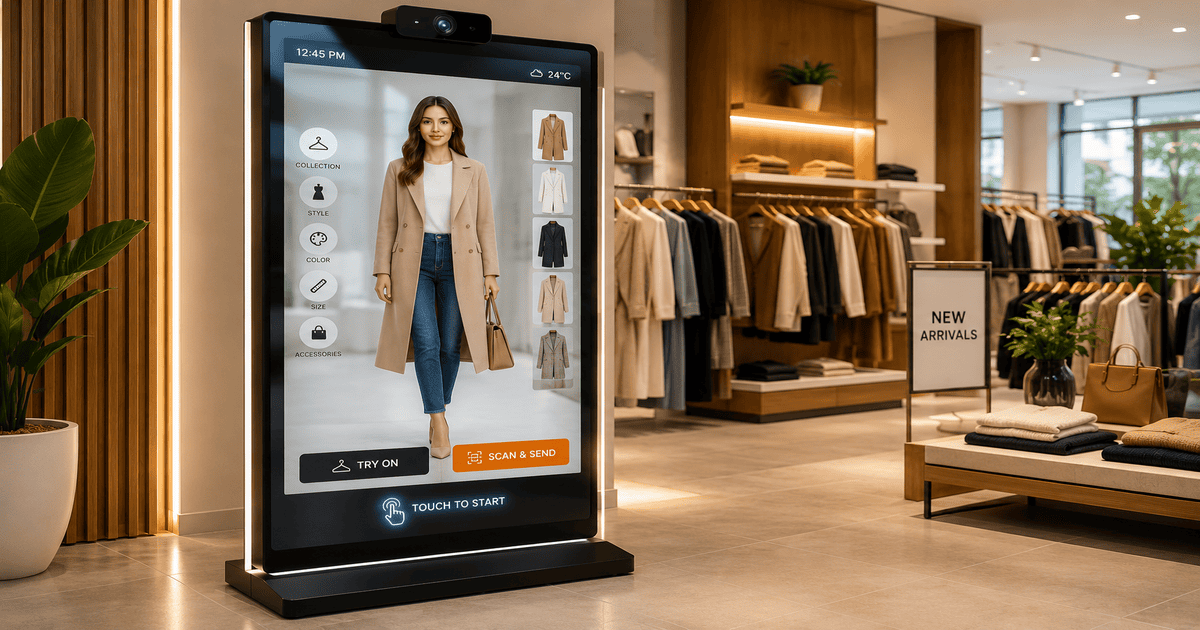
- 1Choose the spot. Trial room entrance, inside a premium trial room, or a QR stand on the floor. Many stores start with one screen at the busiest trial rooms.
- 2Set up the screen. Any touchscreen PC, tablet or large display with a camera. Open the TryOnCloud kiosk in the browser and install it like an app.
- 3Pair it with your store. Enter your Store ID and PIN. The screen is now tied to your store, your catalogue and your plan.
- 4Load your garments. Connect your Shopify store so products sync automatically, or use instant capture, where staff hold a garment up to the camera.
- 5Go live and train staff. Show staff the two-minute flow: pick a garment, shopper stands in front of the camera, result appears, shopper scans the QR to keep it.
Hardware checklist for an AI trial room
There is no special hardware to buy from us. The AI runs in the cloud, so a modest screen is enough. What matters most is the camera view and the light.
| Item | What you need |
|---|---|
| Screen | A touchscreen PC, all-in-one, tablet or large display. Portrait orientation looks most like a mirror. |
| Camera | A webcam or built-in camera that sees the shopper head to toe, about 2 to 3 metres away. |
| Light | Even, front-facing light. Trial room lighting is usually fine; avoid a bright window behind the shopper. |
| Internet | A stable Wi-Fi or wired connection. The AI runs in the cloud, so the screen itself can be modest. |
| Browser | The kiosk runs in a modern browser and installs like an app. No special software to maintain. |
Shopper privacy in an AI trial room
A trial room is a private space, so privacy has to be built in, not added later. TryOnCloud uses the shopper's photo only to create the try-on and does not keep it after generation. The kiosk wipes the previous shopper's session after a few minutes of inactivity, and the result reaches the shopper's phone only when they scan the QR code themselves.
The details are in our privacy policy and our Data Processing Agreement, which cover GDPR and India's Digital Personal Data Protection Act. A simple sign next to the screen explaining that photos are not stored goes a long way with shoppers.
Which clothing brands an AI trial room suits
| Brand type | Best setup |
|---|---|
| Single saree or ethnic wear store | One screen at the trial rooms, plus instant capture for in-store fabrics |
| Bridal and occasion wear boutique | A screen inside the bridal trial room so families can compare outfits together |
| Multi-store ethnic or fashion chain | A screen per store, all managed from one dashboard |
| Menswear and wedding wear brand | Entrance screen for sherwanis, bandhgalas and suits |
| Mall pop-up or exhibition stall | A kiosk with Pay and TryOn so the screen pays for itself |
| Online-first brand | Try-on on your Shopify store, plus a kiosk for your offline outlets |
If you sell online as well, the same engine runs on your website. Shopify brands can add it from the TryOnCloud app on the Shopify App Store, and other websites and apps can use the Developer API.
Frequently asked questions
What is the AI trial room at Isha Ambani's AZORTE stores?
According to press coverage, AZORTE, the fashion brand from Reliance Retail, has smart trial rooms that use RFID tags to recognise the garments a shopper carries in and show them on a screen inside the room. From that screen the shopper can tap to ask for a different size or a matching style, and staff bring it to the room.
Is a smart trial room the same as AI virtual try-on?
No. A smart trial room makes the physical changing room faster: it knows what you brought in and lets you request another size. AI virtual try-on shows the shopper wearing a garment without changing at all, using a photo of their own body. Many brands will want both: virtual try-on to shortlist, the trial room to confirm the final size.
Can a small or mid-size clothing brand build its own AI trial room?
Yes. TryOnCloud runs on a touchscreen or tablet with a camera, so a brand can place an AI try-on station at the trial room entrance, inside a trial room, or let shoppers use their own phone through a QR code. No RFID tagging, custom hardware or in-house AI team is needed.
How much does an AI try-on cost per use?
TryOnCloud's public price is ₹9 per try-on in a 50 pack, ₹8 from 300, ₹7.50 from 1,000 and ₹6.50 from 5,000, bought once and never expiring. In-store kiosk rollouts get a store plan sized to the number of locations; contact us for a quote.
Does AI try-on work for sarees, dhotis and other draped garments?
Yes, with one caveat that matters. Stitched garments like kurtas, sherwanis, salwar suits, shirts and dresses give the most reliable results. Draped garments like sarees, dhotis, veshtis and mundus depend heavily on the photo: a product image showing the garment draped on a model works far better than a flat fabric shot. We recommend testing your own catalogue first, which the free trial allows.
Which clothing types does TryOnCloud support?
Men's, women's and kids' wear, Indian and Western: sarees, lehengas, salwar suits, anarkalis, kurtis, sharara and gharara sets, kurtas, sherwanis, bandhgalas, Nehru jackets, dhotis, shirts, T-shirts, jeans, trousers, blazers, dresses, gowns, co-ord sets and festive and wedding wear for every community. Very fine embroidery may soften slightly, and headwear and jewellery are outside the core garment try-on.
Do shoppers have to install an app?
No. On the in-store kiosk the shopper just stands in front of the screen. On their own phone they scan a QR code and the try-on opens in the browser. The finished look can be sent to their phone by QR so they can share it with family before buying.
What happens to the shopper's photo?
The photo is used only to create the try-on and is not kept by TryOnCloud after generation. The kiosk clears the previous shopper's session automatically after a few minutes of inactivity. Our privacy policy and Data Processing Agreement cover GDPR and India's DPDP Act.
Can we charge shoppers for each try-on?
Yes, if you want to. TryOnCloud's Pay and TryOn option shows a single-use UPI QR on the kiosk, so a shopper pays the amount you set (from ₹1) with GPay, PhonePe, Paytm or any UPI app before the try-on runs. Many brands keep it free; event and mall kiosks often charge.
How long does it take to set up an AI try-on room?
A single screen can be running the same day: pair the screen with your Store ID and PIN, connect your catalogue or use instant capture, and it is live. A multi-store rollout is planned per location, and we help with screen placement and staff onboarding.
Give Your Shoppers an AI Trial Room This Season
You do not need a retail giant's budget. See your own sarees, kurtas and sherwanis on a real shopper in a live demo, then decide.