
Prova Prima di Comprare: Come ASOS, Zara e Nike usano la Prova Virtuale
I grandi brand spendono milioni in tecnologia di prova virtuale. Questa guida spiega esattamente come lo fanno ASOS, Zara, Nike e H&M — e come qualsiasi negozio di abbigliamento puo lanciare la stessa funzione oggi, gratuitamente, in 2 minuti.
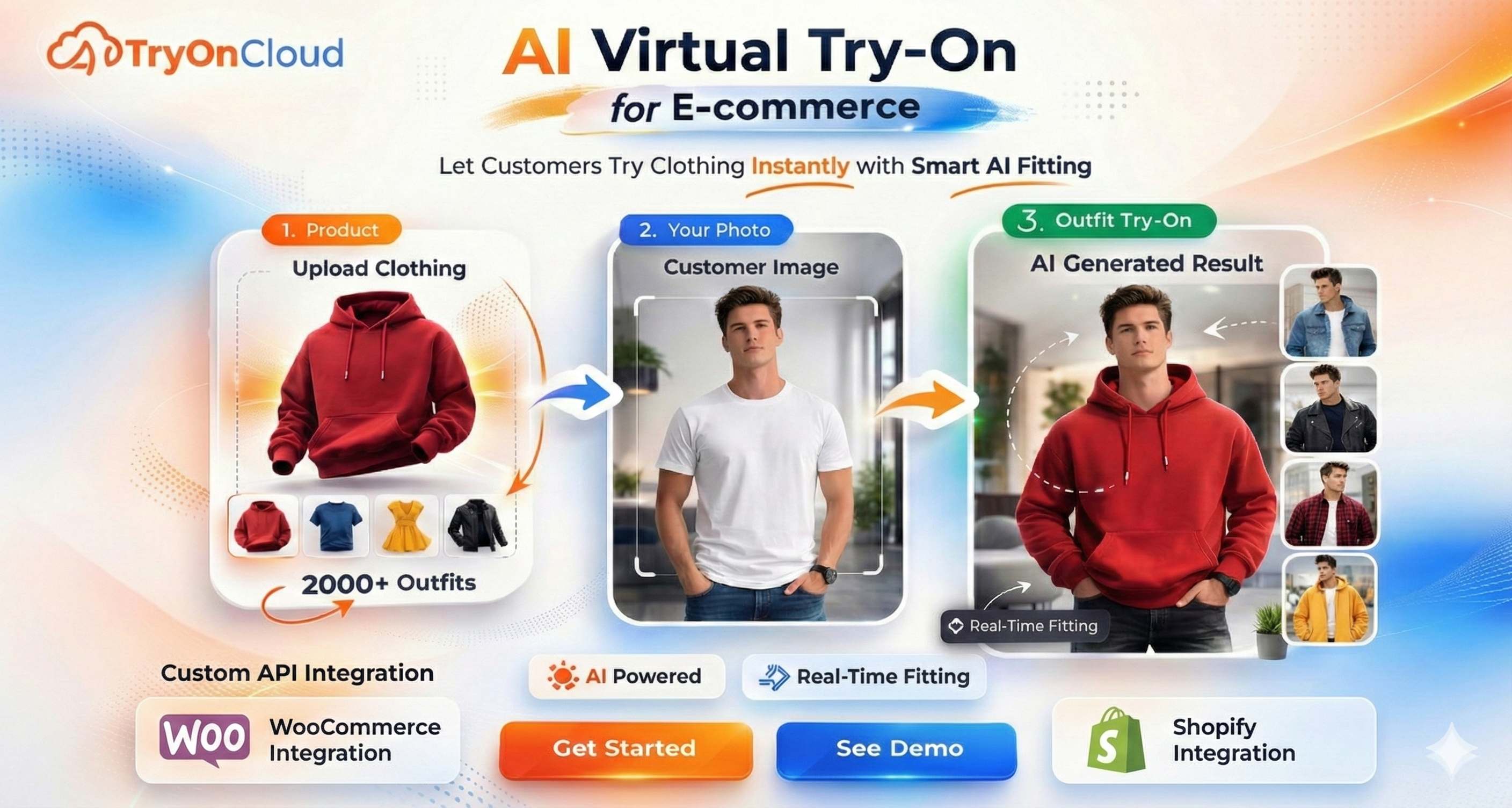
Il motivo principale dei resi e che il capo sembrava diverso sull'acquirente rispetto al modello. La prova virtuale elimina questa incertezza.
The Problem Every Fashion Brand Shares
Online fashion has an unavoidable structural flaw: shoppers cannot touch, try, or wear a product before buying. They rely on flat product images shot on models — and roughly one in three purchases is returned because reality did not match expectation.
This is not a niche problem. Fashion ecommerce loses more money to returns than almost any other category. For a store doing $500,000/year at a 32% return rate, that is $160,000 in returned goods — before you calculate processing, restocking, and customer service costs.
Virtual try-on addresses this at the source. The shopper sees exactly how the garment looks on their own body before buying, so the expectation matches reality and the probability of return drops dramatically.
How ASOS, Zara & Nike Use Virtual Try-On
In 2023, ASOS rolled out AI-powered virtual try-on across its 85,000-product catalogue using a feature called Virtual Catwalk — AI-generated video showing garments moving on different body types, without expensive photoshoots for every size variation. ASOS also offers See My Fit, which lets shoppers choose their height and body type to see the product modelled on someone with similar proportions.
Zara's parent company Inditex invested in augmented reality from 2018, starting with in-store AR experiences where shoppers pointed their phone at a display and saw digital models wearing the current collection. By 2024, Zara extended this to its ecommerce platform, letting shoppers see garments through their phone camera using deep learning models trained specifically on Zara's own catalogue.
Nike's approach focuses on fit prediction for footwear through Nike Fit — a smartphone camera scan measuring 13 points on a shopper's foot to recommend the precise size. For apparel, Nike extended into visual try-on through its apps, showing how products look on different body types. After rolling out Nike Fit, Nike publicly reported a measurable drop in fit-related returns.
H&M built a virtual studio feature generating digital models across 30+ body type combinations, letting shoppers select the closest match to their proportions and see every product visualised accordingly. H&M also partnered with AI startups to enable direct photo-based try-on — the closest model to what TryOnCloud offers independent stores.
What Every Enterprise Solution Has in Common
Despite wildly different technology stacks and budgets, every enterprise virtual try-on solution shares five core characteristics: personalisation to the individual shopper (not a generic model), real garment physics and texture rendering, zero friction embedding directly in the product page, results fast enough to hold attention, and interaction data that feeds back into business decisions.
These five characteristics explain exactly why virtual try-on works — and they translate directly to what any store should look for when choosing a solution.
The Gap: Why Small Stores Were Left Behind
Building a custom virtual try-on system like ASOS requires ML engineers, computer vision specialists, training data, and infrastructure capable of handling thousands of concurrent image generation requests. A realistic budget for a custom enterprise build is $500,000 to $2,000,000 in year one.
Third-party enterprise providers priced accordingly, targeting department stores and large fashion groups. Stores doing less than $5M annually were effectively priced out. A two-tier market emerged: large brands reduced returns and built data advantages through virtual try-on, while small stores continued operating with 30–40% return rates and no way to close the gap.
That changed with TryOnCloud.
How TryOnCloud Closes That Gap
TryOnCloud was built to answer one question: what would it take to give every fashion ecommerce store — not just ASOS, not just Zara — access to the same virtual try-on capability that enterprise brands use to reduce returns and boost conversions?
The answer was a REST API, a Shopify app, and a WordPress plugin. The same AI that powers enterprise virtual try-on is now accessible to any clothing store in the world, without a development team, without a custom build, and without enterprise pricing — starting free, with no credit card required.
The shopper experience mirrors exactly what ASOS and H&M offer: the shopper clicks Try On, uploads a photo, and sees themselves wearing the specific product from your store in approximately 7 seconds. Their photo is deleted immediately after. The result image never carries a watermark; on Growth and higher plans the 'Powered by' badge is removed too for a fully white-label experience.
TryOnCloud adds capabilities most enterprise solutions lack: full support for Indian ethnic wear (sarees, lehengas, kurtis, sherwanis, salwar suits), automatic lead capture after the second try-on, and purchase attribution that links every completed order back to the try-on session that preceded it.
Real Results from Real Stores
TryOnCloud merchants are seeing the same category of results that ASOS and Nike cite in earnings calls — not from ML engineering teams and multi-million dollar budgets, but from a 2-minute Shopify App Store install.
One sustainable fashion brand reported a 31% drop in return rates within 8 weeks. A New York menswear store recorded a 61% try-on conversion rate vs 18% site average. An ethnic wear brand serving the global Indian diaspora cited virtual try-on as the feature that finally let international customers buy confidently across their full saree and lehenga catalogue.
These outcomes mirror enterprise results because the technology works the same way regardless of store size. It shows the shopper themselves wearing the garment, removes purchase uncertainty, and reduces the probability of return.
How to Add Virtual Try-On to Your Store Today
ASOS spent years and tens of millions building its virtual try-on capability. Here is how you do it in 2 minutes, free, with no code required.
Step 1: Install TryOnCloud from the Shopify App Store (or download the WooCommerce plugin from your dashboard). Free — 10 try-ons/month forever, no credit card. Step 2: Open the Shopify Theme Editor and navigate to your product page template. Step 3: In Product Information, click Add block, find TryOnCloud under Apps, and add it. The button appears instantly. Step 4: Optionally configure button colour and text to match your brand — on Growth and higher plans the 'Powered by' badge is removed for a fully white-label experience. Step 5: Start with your 5–10 highest-traffic products, measure the impact on return rate and conversion, then roll out sitewide.
The enterprise brands had a head start. The technology they spent millions building is now available to any store with a Shopify or WooCommerce account, for free, in 2 minutes. The playing field has levelled — the only variable is who acts on it first.
FAQ
Do I need a big budget to add virtual try-on to my store?
No. Enterprise brands like ASOS spent millions building custom solutions. TryOnCloud gives any Shopify or WooCommerce store the same core capability for $0/month on the free plan. No development team, no custom build, no credit card.
How is TryOnCloud different from what ASOS or Zara use?
The core outcome is identical: a shopper sees themselves wearing a garment before buying. Enterprise solutions are custom-built, cost millions, and take 12–18 months to deploy. TryOnCloud installs in 2 minutes from the Shopify App Store and requires zero code. The AI quality is comparable because both use the same underlying generation technology.
Will virtual try-on actually reduce my return rate?
Yes. ASOS publicly reported a significant reduction in returns after rolling out virtual try-on. TryOnCloud merchants report 25–35% fewer returns within 60 days. The mechanism is the same: when a shopper sees the garment on their own body before buying, they make a more informed decision and are far less likely to return it.
Does TryOnCloud work for Indian ethnic wear like sarees and lehengas?
Yes — and this is a key differentiator. Most enterprise solutions are built around Western clothing. TryOnCloud's AI is specifically trained on sarees, lehengas, kurtis, sherwanis, and salwar suits, making it one of the only solutions that handles the full spectrum of global fashion accurately.
Is virtual try-on only for large stores with thousands of products?
No. You can start with just your top 5–10 best-sellers. Many TryOnCloud merchants start with their highest-traffic products, see the return rate drop and conversion lift, then roll out sitewide. You don't need to enable it on every product at once.
What happens to the shopper's photo after the try-on?
It is permanently deleted immediately after the result is generated. TryOnCloud never stores, sells, or uses customer photos for any purpose including AI training. The result image is kept 7 days so the shopper can view it again, then deleted. No watermark on the result image, and no data retention beyond what is necessary.
Related Guides
Usa la stessa tecnologia di ASOS — gratuitamente
10 prove/mese per sempre. Nessuna filigrana sui risultati. Nessuna carta di credito.