
PointAI and ABFRL Virtual Try-On: What Retailers Need to Know
A showcase inside an existing technology partnership, and a long-term ambition attached to it. Here’s what’s actually confirmed, and what smaller retailers can do without waiting for an enterprise rollout.
On August 22, 2026, PointAI showcased its next-generation In-Store Virtual Trial Room and AI Fashion Advisor at Aditya Birla Fashion Excellence Day in Mumbai. The event brought virtual try-on technology into a physical retail setting operated by Aditya Birla Fashion and Retail Limited (ABFRL), one of India’s largest fashion and lifestyle groups. PointAI is already an AI technology partner to ABFRL, and the showcase points toward a possible future rollout of virtual try-on across ABFRL’s stores. No nationwide agreement, rollout schedule, or specific brand within the ABFRL portfolio has been made public.
What PointAI and Aditya Birla Fashion and Retail Limited Announced
The showcase itself is straightforward: PointAI demonstrated its Virtual Trial Room and AI Fashion Advisor at an ABFRL event, in front of an audience that would need to sign off on any wider use of the technology in stores. It's a real step in an existing relationship, not a cold pitch, but it stops short of a confirmed deployment. Nothing public so far sets a store count for a first phase, a timeline, or which ABFRL brand would carry it first.
Fashion Excellence Day itself is an internal ABFRL event, the kind of gathering where a large retailer typically reviews merchandising direction, technology partnerships, and operational priorities for the year ahead with its own teams rather than the public. That context matters for reading the announcement correctly. A technology being shown at an internal event, to an internal audience, is a normal and often early part of how a large retailer evaluates something before it reaches a single store shelf, let alone thousands of them. It's a genuine signal of interest, not a press conference announcing a launch date.
Why the PointAI-ABFRL Relationship Matters
The reason this showcase carries more weight than a typical vendor demo is the relationship behind it. PointAI is already working with ABFRL as an AI technology partner, and Fashion Excellence Day moved that relationship from AI services in general into something a shopper would eventually interact with directly on a store floor. That's a meaningful step. It's still a step, though, not a finish line, and a showcase inside an existing partnership is a different thing from a signed nationwide deployment.
There's a useful distinction between a vendor pitching a brand new retailer and a vendor extending an existing relationship into a new use case. The first involves a sales cycle from scratch, procurement review, and a level of institutional skepticism that any new supplier faces. The second is faster in relative terms, because the trust and the working relationship already exist. That doesn't mean an in-store rollout follows quickly. It means the conversation about one has an easier starting point than it would with an unfamiliar vendor.
For readers tracking the wider AI-in-retail story, that's really the headline here: not a specific store count, but confirmation that Aditya Birla Fashion and Retail Limited is treating in-store virtual try-on as worth serious internal attention, coming from a vendor it already trusts on other AI work. Whether that turns into three pilot stores or three hundred stores over the next year is still an open question.
What the Technology Actually Does
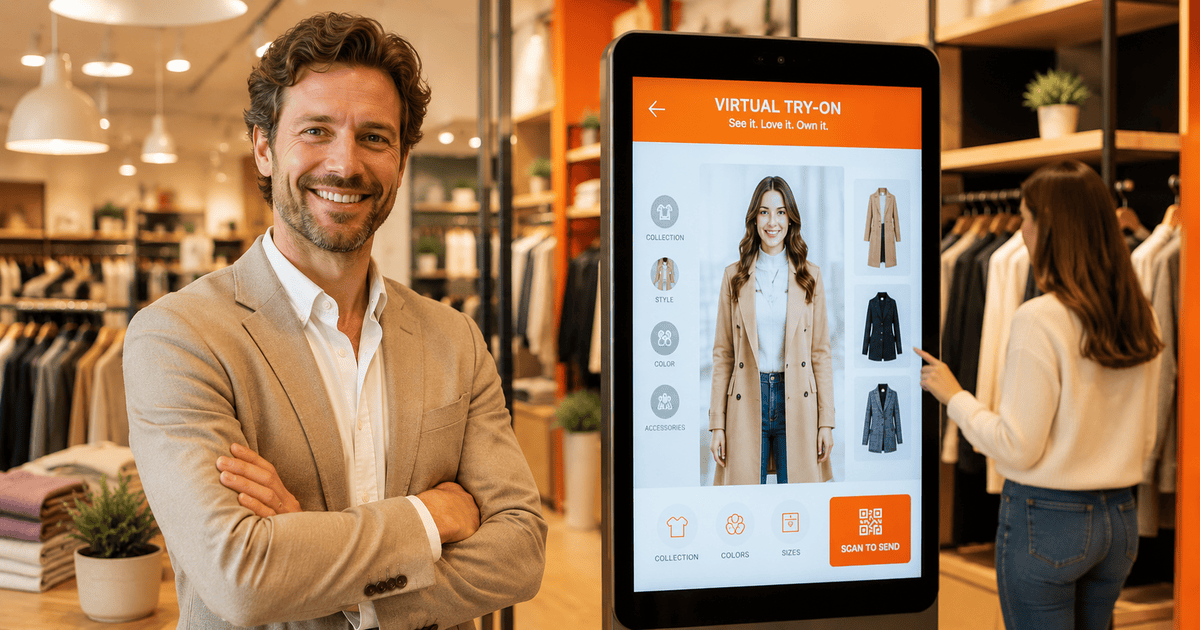
Based on the public announcement, PointAI's In-Store Virtual Trial Room lets a shopper see themselves in a garment digitally rather than physically changing. PointAI says the visualization generates in approximately one second, and that shoppers can explore individual garments as well as complete looks. The company describes this as running on what it calls Simulation AI, a physics-based approach to rendering clothing, which it says has been built using more than 200,000 body-type variations. The showcase also included an AI Fashion Advisor, described as a layer for personalized styling and product recommendations alongside the try-on experience.
These are PointAI's own claims about its own technology. None of the speed or accuracy figures have been independently benchmarked here, and they should be read as vendor-reported until a retailer or third party publishes its own measurements.
It's also worth being clear about what this isn't. Zara's AI Try-On, which some readers may already know, works differently: it builds a personalized avatar from photos a shopper uploads through the Zara app, and Inditex's CEO said it had reached 20 million sessions across roughly 50 markets by May 2026. PointAI's virtual try-on showcase with Aditya Birla Fashion and Retail Limited is a separate implementation, focused on an in-store experience rather than an app-based avatar, and the two shouldn't be treated as the same technology.
The Real Question for Most Retailers
Reading a story about a fashion group the size of Aditya Birla Fashion and Retail Limited evaluating enterprise virtual try-on technology, it's easy to conclude that virtual try-on is a problem to solve later, once budgets look more like ABFRL's. That's the wrong takeaway. The question worth asking isn't whether you can replicate an enterprise deployment. It's whether you can offer your own shoppers a comparable basic experience without needing that infrastructure at all.
A retail group the size of ABFRL is generally working with thousands of stores, an established enterprise IT function, product information systems tying inventory across locations, large catalogs, existing physical retail infrastructure, and budget lines for hardware procurement and system integration. A rollout at that scale is a genuinely different exercise from what a boutique or a mid-size Shopify store needs. Most small and medium retailers are looking for something simpler: a fast setup, low or no upfront cost, integration with a platform they already run, an experience that works in a browser rather than a dedicated app, no special hardware requirement, and a way to see whether shoppers are actually engaging with the feature.
It helps to be specific about what "smaller" actually covers here, because the right next step genuinely differs depending on how a business sells today. A single boutique with no ecommerce presence has a different starting point than a ten-location regional chain that already runs a Shopify storefront alongside its stores, and both are different again from a brand running a custom-built site on its own stack. Treating all of these as one undifferentiated group and pointing them at a single generic answer isn't especially useful, which is part of why the ABFRL story tends to get flattened into "big retailers are doing this, so should you," without much said about how.
A more useful frame is to ask what a retailer already has in place. A store with a website but no app has an easier path through a browser-based widget than through anything requiring a download. A store with heavy walk-in traffic and light online sales gets more immediate value from an in-store option than from a product-page feature few of its customers will ever see. A brand running its own custom platform is really asking a developer question, not a merchant-tooling question, and the API route matches that reality directly rather than forcing a plugin-shaped solution onto a non-plugin business.
How Self-Serve Virtual Try-On Works for Smaller Retailers
This is where a platform like TryOnCloud fits, as one option among several a retailer could evaluate, not as evidence that the ABFRL showcase says anything specific about one vendor over another.
Shopify
Added as an app and placed on product pages through the theme editor, without a retailer needing to build any AI infrastructure themselves. Shoppers can upload a photo or take a live selfie right inside the try-on widget, no file picker needed.
In-Store Kiosk
Runs in a browser on a tablet at the counter or fitting room, letting shoppers try on garments digitally without an app download or dedicated hardware budget. The catalog syncs automatically from Shopify or WooCommerce.
Developer API
For custom or headless ecommerce sites, a developer integrates directly, sending a product image and shopper photo and displaying the result inside the existing storefront. One POST request in, one image out.
None of these paths require negotiating an enterprise contract or building a hardware rollout plan. That's the practical difference between what a company like ABFRL is evaluating and what's already available to a retailer running one store or fifty.
What TryOnCloud Specifically Offers Smaller Retailers
It's easy to assume a self-serve product is a stripped-down version of what an enterprise vendor builds. In practice, some of the more interesting features on a platform like TryOnCloud only make sense at the smaller-retailer scale in the first place. A few worth flagging, specific to TryOnCloud, since these are the kind of details that separate a real product from a basic photo-swap demo:
Instant TryOn
A shopper (or staff member) can hold up any physical garment to the kiosk camera and the AI detects and renders it directly, no barcode, no product listing, no catalog sync required. New or unlisted stock works immediately.
FullFit rendering
Full-length garments render completely regardless of what the shopper is already wearing in their photo: shorts become full trousers, bare arms get sleeves, and sarees or lehengas drape correctly over whatever the shopper had on. Works on the kiosk and every Shopify store.
Pay & TryOn
A store can charge shoppers per try-on with a single-use UPI QR code (GPay, PhonePe, Paytm), set their own price, and a failed generation refunds the credit automatically. Useful for stores that want the kiosk to be self-funding rather than a pure cost center.
Lead capture and attribution
After a shopper's second try-on, an email prompt appears, and every completed order gets automatically matched back to the try-on session that led to it, so a merchant can see which try-ons actually turned into sales.
None of this is a claim that TryOnCloud is technologically ahead of what PointAI or Zara have built. It's a different product built for a different kind of retailer, one that doesn't have an enterprise IT team, but still wants the feature to feel considered rather than bolted on.
Why Now
The PointAI and ABFRL showcase isn't happening in isolation. It comes after a run of similar moves from other companies. Google introduced a virtual apparel try-on feature in India in December 2025, letting shoppers visualize clothing on themselves from a single uploaded photo. Zara's AI Try-On, mentioned above, had reached 20 million sessions by May 2026 according to Inditex.
None of this means every fashion retailer needs to adopt virtual try-on immediately. What it does suggest is that shoppers are increasingly used to interacting with this kind of feature somewhere in their shopping routine, which makes it a more relevant option for a retailer thinking about how to differentiate the buying experience, rather than a novelty limited to a handful of large brands.
It's also worth noting why fashion specifically keeps producing these announcements, rather than, say, electronics or grocery. Clothing is one of the few categories where fit and appearance genuinely can't be verified from a spec sheet or a set of dimensions. A shopper can read a phone's screen size and battery capacity and know almost exactly what they're getting. A shopper reading "regular fit, cotton blend" for a shirt is guessing how it will actually look on their own body. That gap between description and reality is what every version of virtual try-on, PointAI's, Zara's, Google's, or a smaller platform's, is ultimately trying to close, even though each is closing it with a different technical approach and a different amount of friction for the shopper.
Why an Enterprise Rollout Takes Longer Than a Showcase Suggests
None of the following is a confirmed detail about ABFRL's specific plans. It's a general picture of what tends to separate a successful internal demo from a shopper actually using the feature in a store, useful for understanding why "showcased at an event" and "live nationwide" are typically months or years apart for any retailer this size, not just this one.
- Catalog and inventory integration. A retailer with thousands of SKUs across dozens of brands needs the try-on system connected to product data that's accurate and current, which is an ongoing sync problem, not a one-time export.
- Hardware decisions. An in-store trial room implies some combination of screens, cameras, and possibly dedicated compute at each location, all of which needs to be sourced, tested, and budgeted for before a single store gets it.
- Store-by-store rollout logistics. Retailers this size almost never flip a switch everywhere at once. A handful of flagship or pilot stores typically go first, results get reviewed, and the rollout expands in phases over multiple quarters.
- Staff training and support. Store employees need enough familiarity with a new in-store technology to help a confused shopper, which means training materials, a support process, and time.
- Data and privacy review. Any system that processes a shopper's photo, even briefly, tends to trigger a legal and security review at a company ABFRL's size, particularly given how visible data-handling concerns have already become around similar features elsewhere in the industry.
- Commercial terms. Extending an existing technology partnership into an in-store deployment at scale usually means renegotiating or extending a commercial agreement, which takes real calendar time regardless of how well a pilot performs.
None of these stages are unique to PointAI or ABFRL. They're simply what "enterprise retail rollout" tends to mean at this scale, for any vendor and any large retailer. It's also exactly why a small retailer isn't actually behind by not having already solved this: a single-location store skips every one of these stages almost by definition, since there's no multi-brand catalog to sync, no multi-region hardware plan, and no large staff training program to run.
Enterprise Deployment vs Self-Serve: A Practical Comparison
| Factor | Typical enterprise deployment | Self-serve retailer |
|---|---|---|
| Store count | Hundreds to thousands | One to dozens |
| Hardware | Potentially dedicated in-store devices | Existing tablet or browser |
| Integration | Enterprise retail systems | Shopify or direct API |
| Deployment timeline | Phased, over multiple quarters | Typically days |
| Staff training | Often required at scale | Minimal |
| Customization | High | Platform-dependent |
| Commercial model | Enterprise agreement | Subscription or usage-based |
This reflects general patterns in enterprise retail technology rollouts, not confirmed specifics of ABFRL’s own implementation, which hasn’t been made public in this level of detail.
What Self-Serve Virtual Try-On Costs
Enterprise pricing for a deployment like the one ABFRL is evaluating is not publicly available, and would typically be negotiated directly rather than published. Self-serve pricing, by contrast, is usually public and predictable. As one example, TryOnCloud’s own published Shopify pricing runs:
| Plan | INR / month | USD / month | Try-ons |
|---|---|---|---|
| Free | ₹0 | $0 | 10 / month forever |
| Starter | ₹1,600 | $19 | 100 / month |
| Growth | ₹4,200 | $49 | 300 / month |
| Scale | ₹12,000 | $145 | 1,000 / month |
Developer API access for custom-coded sites and kiosks is billed separately as one-time credit packs that, according to TryOnCloud, don’t expire on a monthly cycle. These figures are specific to one vendor and shouldn’t be read as representative of the market as a whole; a different self-serve provider may price differently, and none of this reflects what an enterprise deployment at ABFRL’s scale would actually cost.
What Should a Fashion Retailer Check Before Choosing a Virtual Try-On Platform?
Whether you’re looking at an enterprise vendor or a self-serve platform, these are worth evaluating directly rather than taking on faith from a product page. A vendor demo is built to look good under ideal conditions, with a curated garment, favorable lighting, and a body type the model was clearly trained well on. The real test of any virtual try-on system happens on your own catalog, under your own lighting, with the body types your actual customers have, which is why it's worth running a small trial before committing to a plan or a contract rather than judging a platform purely on its marketing page.
- Rendering speed — how long a shopper actually waits for a result under normal load.
- Garment accuracy — whether the fit and drape look plausible, not just a flat overlay.
- Preservation of prints and logos — whether detail on the garment survives the render.
- Body-type range — whether results hold up across different shapes and sizes.
- Indian clothing categories — whether sarees, kurtis, lehengas, and similar garments are handled specifically.
- Mobile performance — since most fashion shopping happens on a phone.
- Shopify integration — how much setup and developer time is actually required.
- API availability — for retailers running custom or headless platforms.
- Kiosk support — for physical stores wanting an in-store option.
- Privacy and data handling — what happens to a shopper’s photo after the result is generated.
- Analytics — whether usage data ties back to actual purchase behavior.
- Cost per try-on — the real cost at your expected volume, not just the listed plan price.
- Catalog onboarding — how much work it takes to get your existing product photos into the system.
- Measuring conversion impact — whether the platform can show data specific to your own store, not industry-wide figures.
No single vendor, including TryOnCloud, should be assumed to lead on every one of these. The list is meant to give a retailer a way to compare options on their own terms.
Turning Virtual Try-On Into First-Party Leads
Beyond the try-on experience itself, some platforms use it to build a customer list. TryOnCloud, for example, prompts a shopper for their email after a second try-on rather than immediately, and creates a Shopify segment for shoppers who've used the feature.
If you evaluate this kind of feature, confirm exactly when and how consent is collected, since email capture tied to a product interaction needs to fit your own privacy policy and applicable marketing rules. Captured emails appear in your Leads dashboard with the product tried, the date, and Shopify tag status. Every try-on user is automatically tagged "tryoncloud-user" in Shopify. On install, TryOnCloud creates a dedicated "Virtual Try-On Users by TryOnCloud" segment — ready for targeted email campaigns in Shopify Marketing with zero setup.
How to Start This Month
None of the paths below require an enterprise sales process or a long contract, at least for the self-serve options most small and mid-size retailers would use.
- Shopify merchants can install a try-on app from the Shopify App Store and add it to a product page template through the theme editor, typically without writing any code.
- Physical stores without an ecommerce presence can start with a kiosk-style setup, usually a tablet running in a browser, and test it on a handful of products before deciding whether to expand it store-wide.
- Custom or headless ecommerce businesses will generally need a developer to integrate an API, sending a product image and a shopper photo and displaying the result within the existing site design.
Whichever path fits, it’s worth testing on a small slice of your actual catalog first, rather than assuming a demo, PointAI’s or anyone else’s, translates directly to your own products, your own lighting, and your own customers.
For more on virtual try-on for Indian fashion ecommerce, see AI Virtual Try-On for Indian Fashion Ecommerce. For in-store deployment, see the best virtual try-on kiosk options for clothing stores. Shopify merchants can also read the step-by-step guide to adding virtual try-on to Shopify.
Frequently Asked Questions
Ready to test virtual try-on without an enterprise rollout?
Start free — 10 try-ons/month forever, no credit card. Then scale into a Shopify plan, an in-store kiosk, or the Developer API.