
Comparison
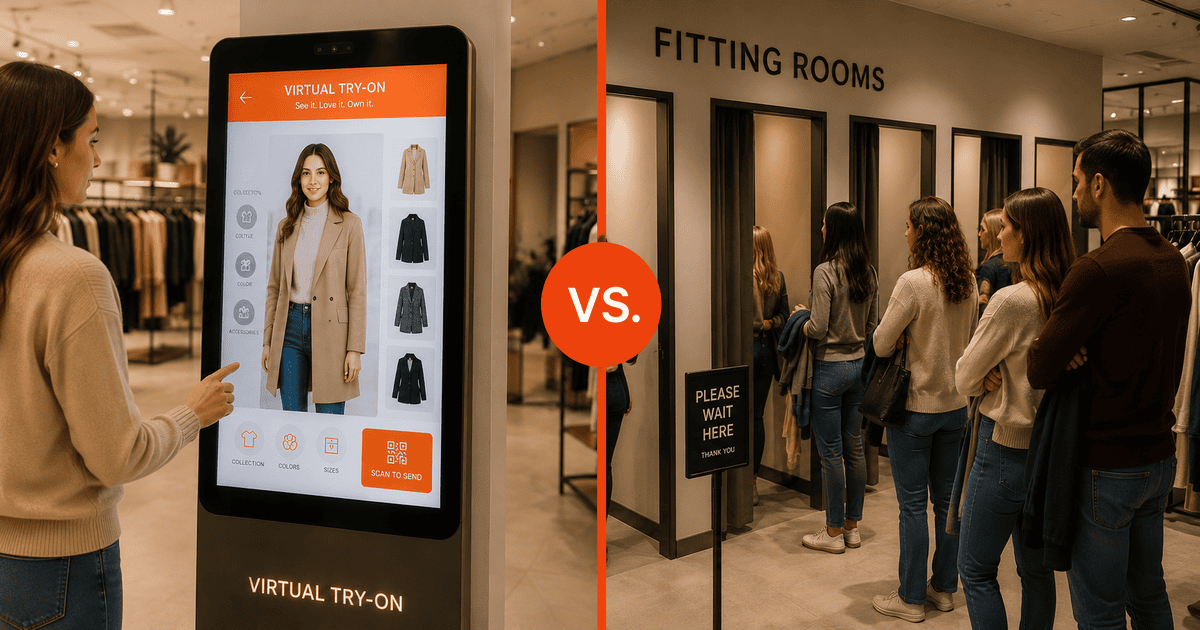
Virtual Try-On Kiosk vs Fitting Room
The fitting room has been the heart of the clothing store for a century, and it is not going away. But it has always carried a cost: queues, floor space, staff to manage it, and a hard limit on how many items a shopper can try. The virtual try-on kiosk does not try to abolish the changing room — it removes the friction around it. This is an honest comparison of the two, including where each one genuinely wins.
The short verdict
A kiosk beats a fitting room on speed, queues, floor space, and the number of items a shopper can try. A fitting room still wins when the shopper needs to feel the fabric and check a precise physical fit. Most stores get the best result by keeping one or two changing rooms and adding a kiosk to take the load.
Side-by-Side Comparison
| Factor | Virtual try-on kiosk | Fitting room |
|---|---|---|
| Time per try-on | ~7 seconds | 5-10 minutes |
| Queue at peak | None — self-service | Common and frustrating |
| Floor space | One small footprint | Several square metres each |
| Items tried per visit | Unlimited, instantly | One outfit at a time |
| Staff needed | None | Often required |
| Shareable result | Yes — image to phone | No |
| Feel the fabric | No | Yes |
| Precise physical fit | Preview only | Exact |
| Setup cost | Low — same-day | High — construction |
| Cleaning / upkeep | Minimal | Ongoing |
Where the Kiosk Wins
The kiosk's advantage is concentrated in the moment of curiosity. A shopper holding an item, unsure whether the colour suits them, faces a choice: commit to a fitting-room trip or put it back. Most put it back. The kiosk turns that hesitation into a seven-second preview, and a preview that costs nothing gets used constantly. It is fastest where speed matters most — the impulse try, the "I wonder how this looks," the quick check before deciding.
Peak-hour traffic
When the changing-room queue is longest, the kiosk has no queue at all.
Exploratory shopping
Shoppers preview many items because each one costs seconds, not minutes.
Impulse decisions
A quick, believable preview prevents the poor buy that would come back as a return.
Shareable moment
The shopper leaves with an image to show a friend, which markets the store for free.
Where the Fitting Room Still Wins
It would be dishonest to claim the kiosk replaces everything. There are moments where the physical changing room is still the right tool, and pretending otherwise would set up a store to disappoint shoppers.
Feeling the fabric
Texture, weight and stretch matter for some purchases, and only a physical try-on tells you.
Precise fit on the body
For tailored or fit-critical pieces, the shopper wants to move in the garment and check it exactly.
High-value items
Before a significant purchase, many shoppers want the reassurance of trying it on properly.
Shoppers who prefer it
Some simply like the ritual of the changing room, and a good store respects that.
Why Most Stores Use Both
The smartest setup is not kiosk-or-fitting-room; it is kiosk-and-fitting-room, with each doing what it is best at. The kiosk soaks up the high-volume, quick, exploratory try-ons that would otherwise jam the changing-room queue. The fitting rooms — now far less crowded — are free for the shoppers who genuinely need them. The store ends up serving more people, faster, while still offering the full physical try-on for the moments that call for it. You also reclaim selling space, because you no longer need a wall of changing rooms to handle the rush.
Think of the kiosk as a pressure valve on your fitting rooms. It does not replace them — it stops them from being the bottleneck that costs you sales on a busy day.
Common Questions
Should I get rid of my fitting rooms?+
Almost never entirely. A kiosk handles the quick, exploratory try-ons that clog the changing-room queue, but some shoppers still want to feel the fabric and check the fit physically before a bigger purchase. The winning setup for most stores is to keep one or two fitting rooms and add a kiosk to absorb the volume.
Which is faster, a kiosk or a fitting room?+
A kiosk, by a wide margin. A try-on on the kiosk takes seconds; a fitting-room trip takes minutes once you count undressing, dressing, and the walk. At peak hours the gap widens further because the fitting room also adds queue time.
Does a kiosk save floor space?+
Yes. A kiosk occupies one small footprint, while fitting rooms take several square metres each plus the corridor and mirrors around them. Reclaiming even one or two changing rooms for selling space is a real estate win in a busy store.
Which reduces returns more?+
Both help, but a kiosk has a particular edge for impulse and exploratory shopping, where a quick preview prevents a poor buy that would otherwise come back. Physical try-on is still strong for fit-critical items. Used together, they cover both cases.
Is a kiosk cheaper than building more fitting rooms?+
Generally yes. Adding fitting rooms means construction, mirrors, lighting, and lost selling space. A kiosk runs on a touchscreen you can deploy the same day, with no construction and a small footprint.