
Snitch AI Virtual Try-On in Stores: What the Beta Means for Indian Fashion Brands
One of India's best known menswear brands is putting AI try-on mirrors in front of real shoppers. Here is what was announced, how the technology works, and how any clothing brand can run the same kind of test in its own stores.
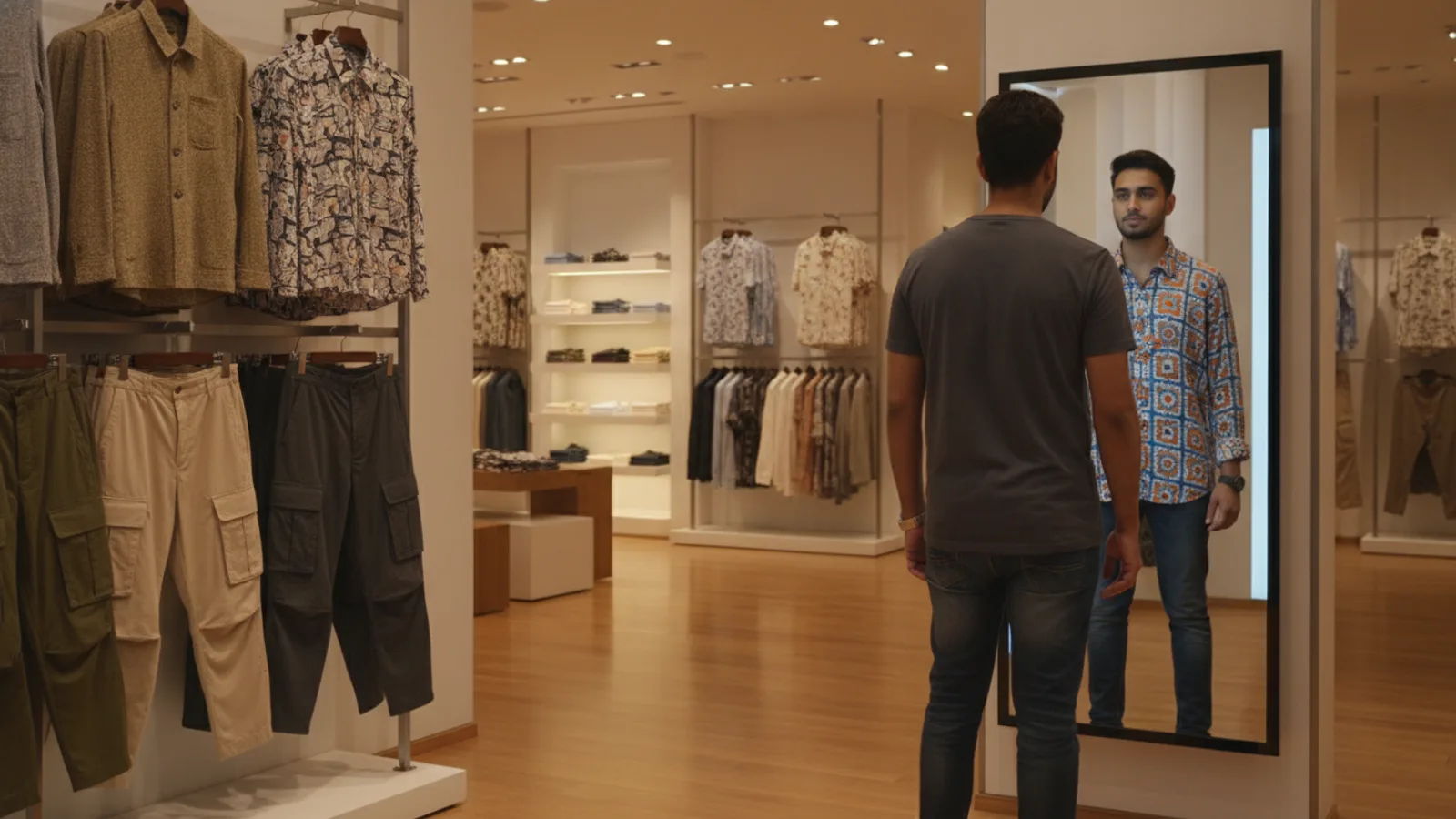
Snitch, the fast-growing Indian menswear brand, has started testing AI virtual try-on in its physical stores. According to a November 2026 report by Indian Retailer, the brand is trialling AI-powered digital mirrors at select stores in India, built by fashion-tech company Flickd. Shoppers can see how a garment looks on them on a screen, without first carrying it into a changing room.
It is a beta, not a national launch. The report says Snitch and Flickd will study how customers interact with the mirrors, how often they are used and how effective they are before deciding whether to roll the technology out more widely. That makes it one of the more interesting retail technology stories in India this year: a digital-first brand that grew up online is now testing whether AI can make its offline stores work better.
This article covers what was actually announced, how in-store AI try-on works, why menswear is a natural fit for it, and what any clothing brand, from a single store to a regional chain, can learn from Snitch's approach. If you run a fashion store and searched for Snitch virtual try-on because you want the same technology, the last third of this piece is a practical plan you can start this month.
What Snitch Apparels Private Limited Announced
Snitch is the consumer brand of Snitch Apparels Private Limited, the Bengaluru company founded by Siddharth Dungarwal. The announcement, as reported, is short and specific. Snitch is testing AI-powered virtual try-on technology at select stores. The partner is Flickd, a fashion-technology company. The deployment is described as a beta. Wider deployment depends on what the beta shows.
Flickd's co-founders are quoted in the report. Dheekshith Kumar says early interest has been encouraging and that “The testing with Snitch gives us an opportunity” to understand how shoppers behave in a live store. Sheetal Singh describes the introduction as just the beginning and says the team will keep learning from shopper responses. Those are the companies' own descriptions of an early test, and they are worth reading as exactly that.
What the report does not include is just as useful to know, simply so nobody over-reads the news. There is no published list of stores in the beta, no store count, no launch date for the wider network and no shopper numbers yet. That is normal for a retail pilot. Brands rarely publish beta numbers until they have decided what to do next.
The confirmed facts, in one place
- Brand: Snitch (Snitch Apparels Private Limited), menswear.
- Technology: AI-powered virtual try-on on digital mirrors in stores.
- Partner: Flickd, a fashion-technology company.
- Stage: beta at select stores in India.
- What is being measured: customer interactions, usage patterns and effectiveness.
- Next step: a wider rollout depends on the beta results.
Who Snitch Is, and Why Stores Matter to It
Snitch began as an online menswear label and built its following through its own website, its app and social media, selling trend-led shirts, overshirts, trousers, cargos, denim and co-ord sets at accessible prices. Its pace is fast fashion pace. New styles land constantly, and a large share of the range changes from season to season.
Over the last few years the brand moved aggressively into physical retail, and it now runs well over a hundred stores across Indian cities, according to public reports. That shift is the background to this beta. A brand that learned its trade online is used to data: it knows which products get clicked, which get added to cart and which get returned. A physical store gives far less of that signal. A shopper picks up a shirt, looks at it, puts it back, and the brand never learns why.
An AI try-on mirror changes that. Every try-on is a recorded interest in a specific product, from a specific store, at a specific time. For a brand with an online mindset, that alone is a strong reason to test the technology, separate from any lift in sales. It is a way of bringing some of the visibility of ecommerce onto the shop floor.
Snitch is not the only Indian retailer moving this way. Reliance Retail's AZORTE has put AI trial rooms in its stores, which we covered in Isha Ambani's AZORTE AI trial rooms, and Aditya Birla Fashion and Retail has shown in-store try-on technology too, covered in PointAI and ABFRL virtual try-on. Snitch is notable because it is a younger, digital-first brand, which suggests in-store try-on is no longer only a big conglomerate experiment.
Why Snitch Is Running a Beta First
A beta is the sensible way to put new technology into stores, and Snitch's approach is a good model for any retailer. In-store technology has a long history of looking impressive at launch and gathering dust six months later. Screens that nobody touches, kiosks that staff quietly switch off because they slow down the queue, mirrors that only work in perfect lighting. A short, measured test catches those problems before they are repeated across a whole network.
There are three questions a beta like this can answer that no demo can.
Do shoppers actually use it?
A mirror that is admired and ignored is worthless. The first thing any brand needs to know is whether real customers, on a busy Saturday, walk up and use it without being prompted, and whether they use it more than once.
Does it fit the way the store runs?
Store staff have a lot to do. If the try-on screen needs constant help, crashes, or creates a second queue next to the changing rooms, staff will stop recommending it. A beta shows how the technology behaves inside normal store operations, which is very different from a launch event.
Does it change what people buy?
This is the hardest to prove and the most important. The report says the companies will look at effectiveness, and for a retailer effectiveness usually means some mix of conversion, basket size and fewer garments left crumpled in fitting rooms. These numbers take weeks to read properly, which is why a beta has to run long enough to see a pattern rather than a first-week novelty spike.
How an AI Virtual Try-On Mirror Works
The phrase “AI mirror” covers a few different technologies, so it helps to be precise. The report does not describe Flickd's system in technical detail, so the explanation below covers how in-store AI try-on generally works, not the specifics of the Snitch setup.
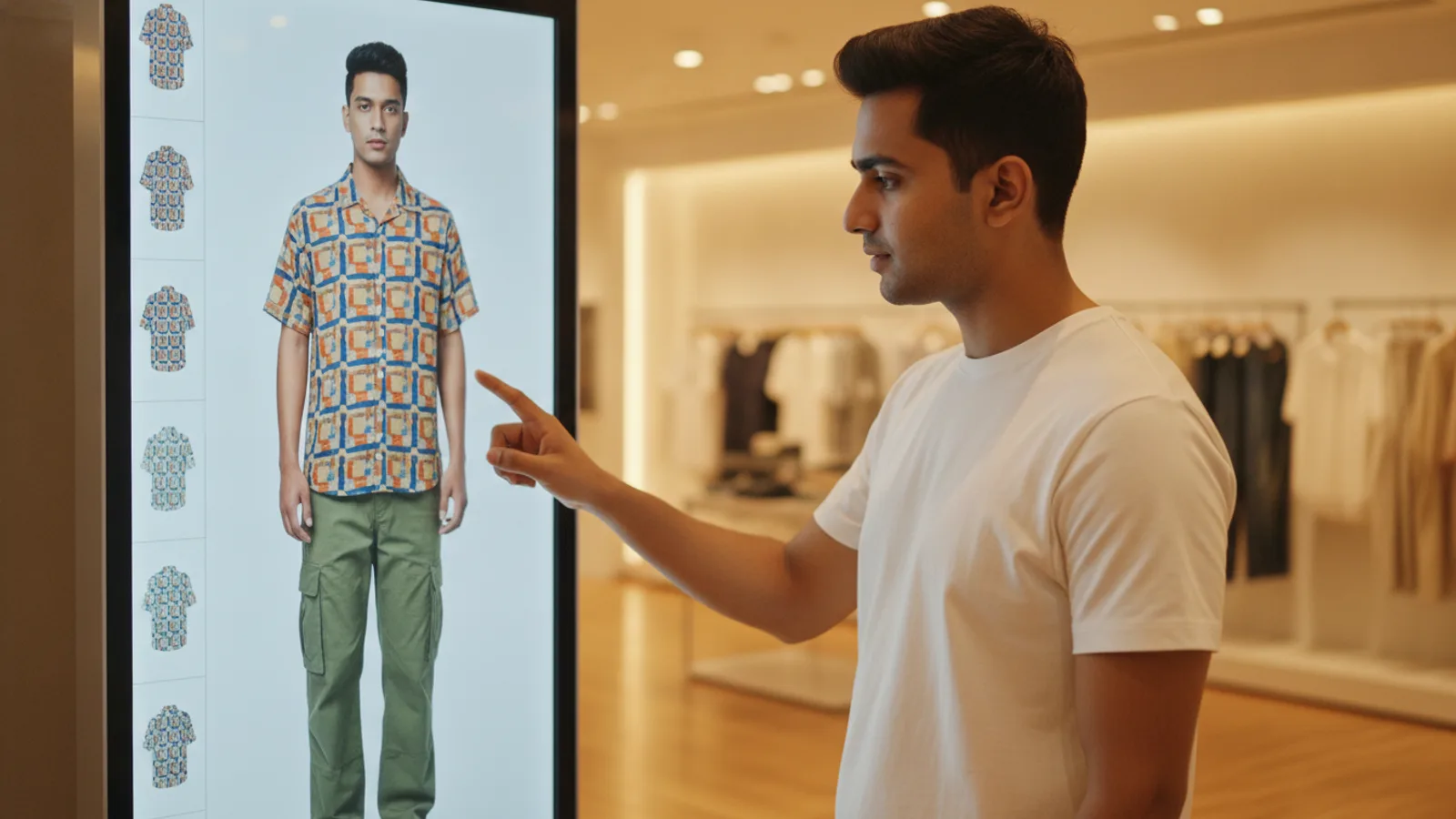
- Capture. A camera on the mirror or screen takes a photo of the shopper, usually full length or from the waist up.
- Choose. The shopper picks a garment. On most systems this is a catalogue on the screen. Some systems also let a shopper or staff member hold a real garment from the rack up to the camera.
- Generate. An AI model creates a new image of the shopper wearing that garment, keeping the shopper's face, body shape and pose, and keeping the garment's colour, print and cut.
- Show and share. The result appears on the screen. Good systems let the shopper send it to their own phone, usually by scanning a QR code, so they can think about it, share it with a friend, or buy it later.
This is different from the older generation of “magic mirrors” that pasted a flat garment image over a live video of the shopper. Those overlays looked like a sticker and broke as soon as the shopper moved. Generative AI try-on produces a still image instead, but one that looks like a photo of the person actually wearing the garment, with realistic folds, shadows and fit. For a shopper deciding between three printed shirts, a convincing still image is far more useful than a wobbly live overlay.
For a deeper explanation of the hardware and software side, see how a virtual try-on kiosk works.
Why Menswear Fast Fashion Suits Virtual Try-On
It is no accident that a menswear brand like Snitch is testing this. Several features of the category make AI try-on a particularly good fit.
Prints and colours are the decision. Much of a fast-fashion menswear range is shirts and overshirts where the cut is familiar and the real question is “does this print suit me?” That is exactly the question a try-on image answers well. A shopper who already knows his size mostly needs to see the colour against his skin tone and the print on his frame.
Many men avoid changing rooms. Retail staff across India will tell you the same thing: plenty of male shoppers pick a size, skip the trial room and hope for the best. Some of those purchases come back. A screen that shows the garment on them, with no undressing and no queue, gives those shoppers a reason to look before they buy.
The range changes constantly. A brand dropping new styles every week cannot reshoot every product on dozens of body types. AI try-on puts every new style on every shopper from a single product photo, which suits a fast-moving catalogue.
Weekend crowds create queues. Mall stores in Indian cities get very busy on weekends and around festive sales. If a shopper can rule out four of six shirts on a screen, the fitting room only sees the two serious candidates. That is better for the shopper and better for the staff tidying up afterwards.
The same reasoning applies well beyond menswear. Indian ethnic wear, kurtas, kurta sets, sherwanis and women's suits, is another category where the look of a colour or embroidery on a shopper decides the sale. We cover the broader Indian picture in AI virtual try-on for Indian fashion.
One Technology, Two Places: Store and Phone
Most coverage of the Snitch beta focuses on the mirror in the store. The bigger idea is that the same AI can work in both places a shopper meets a brand: the store and the phone.
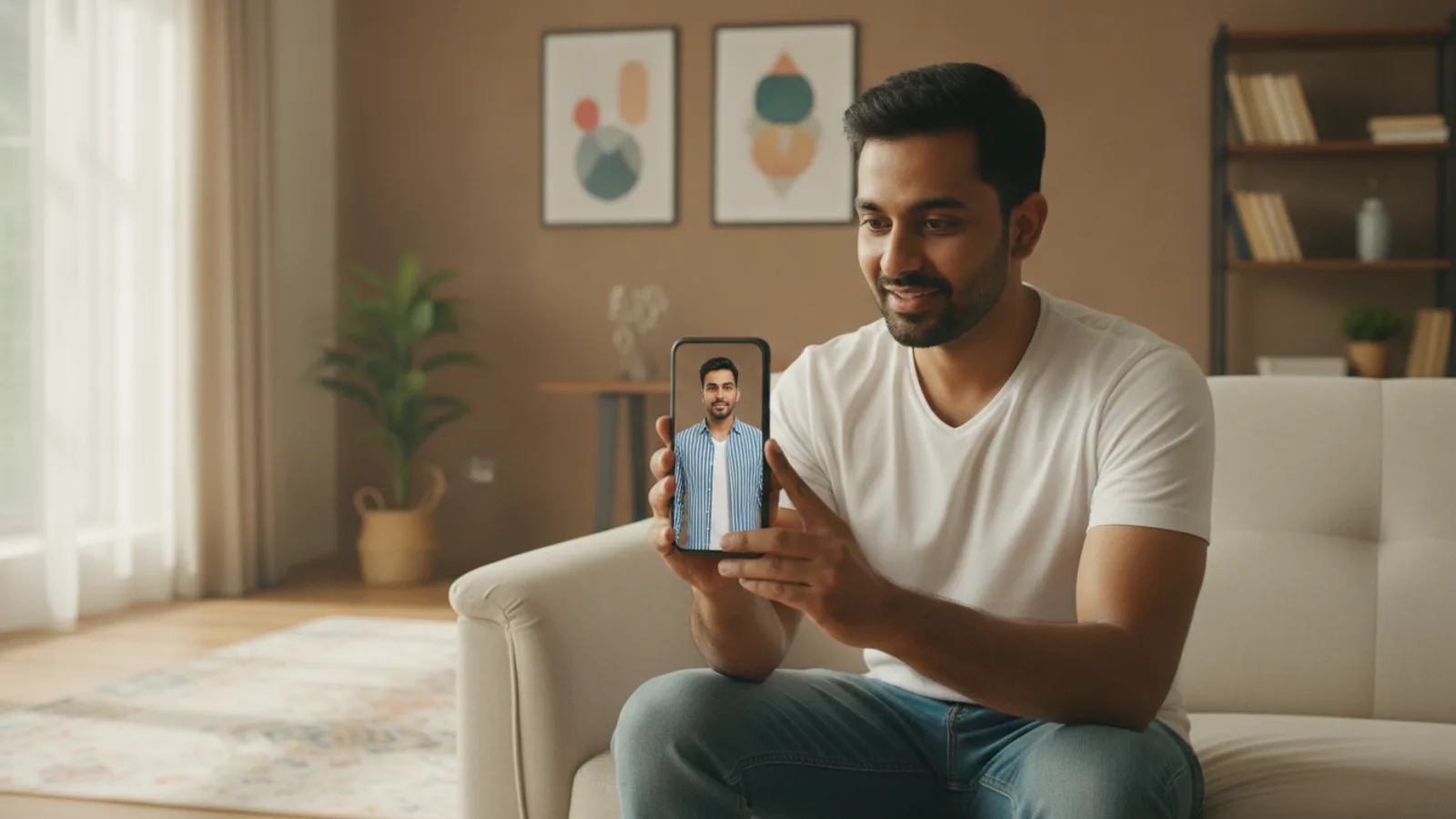
Online, virtual try-on sits on the product page. A shopper uploads a photo once and sees products on themselves before adding to cart. In the store, the try-on runs on a screen. A brand that connects the two can let a shopper try something in store, send the image to their phone, and finish the purchase online that evening if the size they wanted was out of stock. Or the reverse: try online, then walk into the nearest store to buy.
For digital-first brands like Snitch, this connection between channels is likely more valuable than either surface on its own. For smaller brands, it means the decision is not “website or store”. You can start with whichever channel brings most of your revenue and add the other later on the same platform.
What a Try-On Beta Should Measure
The report says Snitch and Flickd will look at customer interactions, usage patterns and effectiveness. Those three areas are a good template for any retailer planning its own test. Here is what each one looks like in practice.
| Area | What to measure | Why it matters |
|---|---|---|
| Customer interactions | Share of store visitors who start a try-on; repeat try-ons per shopper; how many send the result to their phone | Shows whether shoppers find it useful without staff pushing it |
| Usage patterns | Busiest hours and days; most tried-on products and categories; stores with high and low use | Tells you where to place screens and which products to feature |
| Effectiveness | Conversion for shoppers who used try-on compared with those who did not; fitting room load; return rate on tried-on items | The business case for a wider rollout |
| Operations | Staff time spent helping; downtime; result quality complaints | Decides whether the technology survives past the pilot |
One practical tip: decide on the comparison before the beta begins. If you only look at try-on shoppers, you will see high conversion and conclude the technology works, when in reality the people who stop at a mirror were already more likely to buy. Compare with similar stores without the screen, or the same store in the weeks before it, so the result means something.
How Any Indian Clothing Brand Can Do This
Snitch has the scale to run a pilot with a technology partner. Most clothing businesses in India, a family-run store in Hyderabad, a regional ethnic wear chain, a D2C label opening its first two outlets, do not need that. In-store AI try-on is now available as a self-serve product that runs on hardware a store may already own.
TryOnCloud is one of those platforms. It runs in three places, and a brand can use one, two or all three.
1. In the store: the try-on kiosk
The TryOnCloud virtual try-on kiosk runs in a web browser on any touchscreen, tablet or large display with a camera, including Windows touch PCs. There is no special mirror to buy. A store pairs the screen with its account using a Store ID and PIN, and it can go live the same day.
- Catalogue sync: products sync automatically from the store's Shopify catalogue.
- Instant capture: a shopper or staff member holds any physical garment up to the camera and tries it on, with no catalogue entry. This is useful for stores whose stock changes faster than their product photos.
- Phone handoff: shoppers can send a photo from their own phone by QR code and receive the result on their phone by QR code. No app install.
- Session reset: the previous shopper's session clears automatically after a few minutes of inactivity.
- Quality check: every result passes an automatic quality check before the shopper sees it.
- Optional Pay and TryOn: the store can charge from ₹1 to ₹1,000 per try-on through a single-use UPI QR (GPay, PhonePe, Paytm), which suits malls, events and stalls.
If you are comparing hardware options, read the best virtual try-on kiosk for clothing stores and try-on kiosk vs fitting room.
2. Online, for Shopify stores
Brands selling on Shopify can add a “Try it on” button to product pages by installing the TryOnCloud app from the Shopify App Store and enabling it in the theme editor. No code. The same Shopify catalogue then powers the kiosk in your store, so online and offline use one product list.
3. Custom websites and apps: the API
Brands on a custom website, a headless storefront or their own mobile app can connect through the TryOnCloud virtual try-on API. A developer sends a garment image and a shopper photo in one request and gets the try-on image back. There is a free test mode, so a team can build the whole flow before spending anything.
Enterprise Pilot vs Self-Serve Try-On
Neither route is better in every case. A large chain with hundreds of stores may want a dedicated partner and custom hardware. A smaller brand usually wants something it can switch on, test and pay for as it goes. The table compares the two routes in general terms.
| Enterprise pilot (like the Snitch beta) | Self-serve platform | |
|---|---|---|
| Getting started | Partnership talks, scoping, a planned pilot | Sign up and pair a screen, often the same day |
| Hardware | Often a dedicated mirror or display chosen with the partner | Any touchscreen, tablet or large display with a camera |
| Catalogue | Integrated with the brand's systems | Synced from Shopify, or instant capture of the physical garment |
| Pricing | Negotiated privately | Published plans and per try-on pricing |
| Best for | Large chains with in-house technology teams | Single stores, regional chains and D2C brands opening outlets |
| Online try-on | Separate project | Same platform through a Shopify app or API |
What In-Store Virtual Try-On Costs
The cost of the Snitch beta has not been published, and enterprise pilots are almost always priced privately. What a smaller brand can look at is published pricing from self-serve platforms.
At TryOnCloud, kiosk try-ons are metered on the store's plan, and multi-store rollouts are quoted per brand. The Shopify app has a Free plan with 10 try-ons a month, paid plans start at $19 a month for 100 try-ons, and the full list is on the pricing page. The Developer API is pay as you go, from ₹6.50 per try-on at volume in India, with credits that never expire. These are TryOnCloud's own prices, given as one example, not an industry average.
The hardware is the other cost. Because the kiosk runs in a browser, many stores start with a tablet or an existing touchscreen and only invest in a larger display once they know shoppers use it. That is the self-serve version of what Snitch is doing with its beta: prove usage first, then spend.
Shopper Privacy in the Store
An AI mirror takes a photo of a customer in a public place, so privacy should be part of any rollout plan from day one, not an afterthought. India's Digital Personal Data Protection Act makes clear consent and limited retention the expected standard, and shoppers notice when a brand gets this right.
- Tell shoppers on the screen what happens to their photo before it is taken.
- Ask every provider how long images are kept, where they are stored and who can access them.
- Make sure one shopper's photo or result can never be seen by the next person at the screen.
- Only take photos of children with a parent's consent.
TryOnCloud's kiosk clears the previous session automatically after a few minutes of inactivity, and results can go straight to the shopper's own phone by QR code rather than staying on a shared screen. Whatever provider you choose, put these questions in writing before you sign.
Run Your Own Try-On Beta in Four Weeks
You do not need to wait for a technology partnership to test what Snitch is testing. Here is a simple plan for a single store or a small chain.
- Week 1, set up. Pick one store with steady footfall. Place a touchscreen or tablet near the most popular rack, not hidden in a corner. Sync your catalogue or choose twenty to thirty best sellers. Train the floor staff in a short session.
- Week 2, launch quietly. Let staff suggest the screen to shoppers who are undecided between two or three items. Watch for problems with lighting, placement and queues, and fix them early.
- Week 3, measure. Track try-ons per day, the most tried-on products and how many shoppers send results to their phones. Compare sales of featured products with the previous weeks.
- Week 4, decide. If shoppers use it and staff support it, add a second store or connect online try-on through Shopify. If not, you have learned that cheaply, on hardware you already own.
The most common mistake in a try-on pilot is judging it on the first few days, when curiosity inflates usage, or on a quiet weekday, when nobody is in the store. Four weeks covers enough weekends to see a real pattern.
Snitch's beta is a signal that in-store AI try-on in India is moving from showcase to serious testing. The brands that learn the most from it will be the ones that run their own small test now, on their own products and their own customers, rather than waiting to see what a larger brand decides. For a full setup guide, read the virtual try-on kiosk guide, or see Instant TryOn and pay per try-on if you want to try the paid model.
Frequently Asked Questions
Run your own AI try-on beta this month
Put virtual try-on on your Shopify product pages and on a screen in your store, from one catalogue.